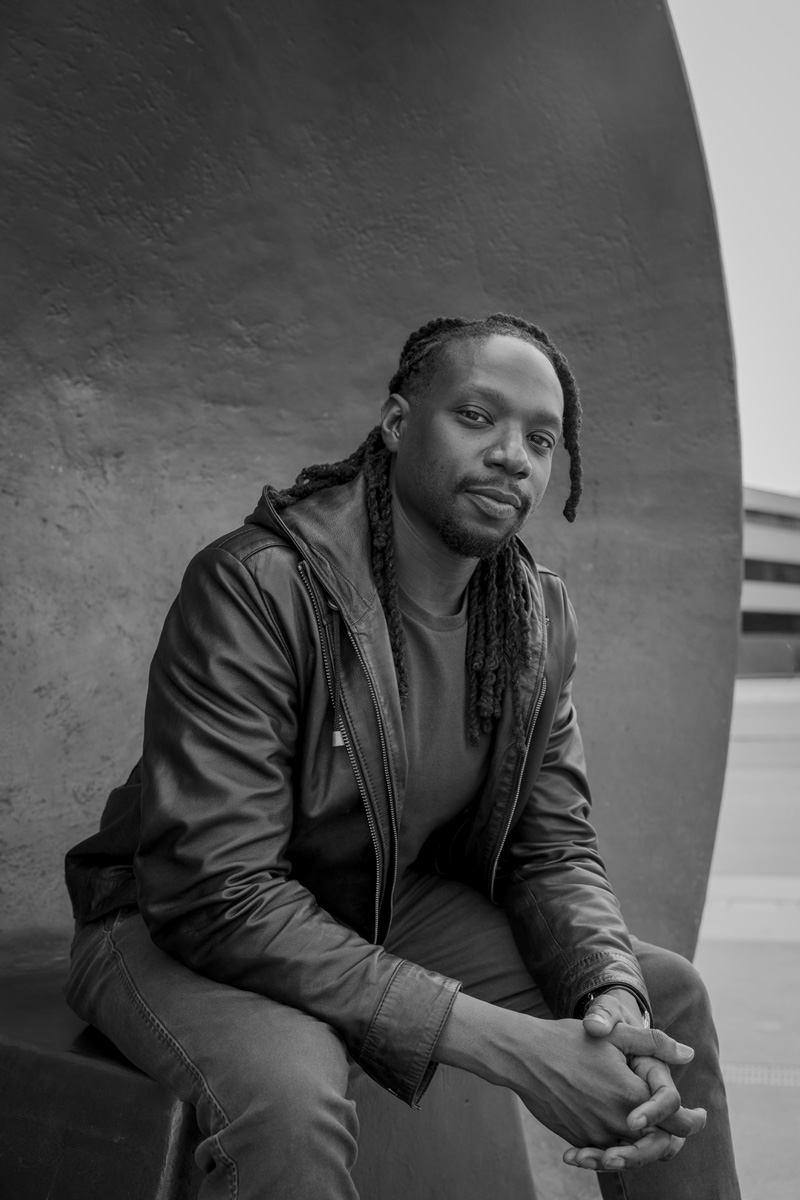
James Allister Sprang is a multidisciplinary artist, composer, and technologist working across spatial sound, photography, installation, performance, and poetry. His practice has taken many forms, but its questions have remained remarkably consistent: How do we listen? How does perception shape what we understand to be true? What happens when sound, image, language, architecture, and the body are allowed to tell a story together? Sprang describes the resulting works as audiovisual poems for the spirit—immersive environments that celebrate the sensorial experience of Black life while exploring memory, resilience, rest, and interiority.
Over the course of his career, Sprang has participated in more than twenty-five residencies and fellowships and received direct support from many of the country’s leading arts funders, including Pew Center for Arts & Heritage, Doris Duke Foundation, Mellon Foundation, Knight Foundation, and United States Artists. His work has drawn critical attention from Artforum, Art in America, Art Papers, The Observer, Forgotten Lands, and numerous other publications. Today, he owns a 36-speaker 4DSound system and is the only person of color known to own the technology worldwide—an unusual position that reflects an increasingly ambitious relationship between art, sound, and infrastructure at the center of his practice.
Sprang was born in Brooklyn and raised in Miami. As a child, his father collected discarded drawings from the floor of his room and submitted them as a portfolio to an art magnet school.
Sprang was accepted soon after learned of The Cooper Union, a college in New York where every admitted student receives a full-tuition scholarship. Still in middle school, Sprang decided that Cooper was where he would have to study to pursue his interests.
He later attended Miami’s Design and Architecture Senior High School, where painting remained central to his development but his understanding of what an artwork could be began to expand considerably. There, Sprang studied performance with Fernando Calzadilla, who was then pursuing doctoral work in NYU’s Performance Studies program and studying with Fred Moten. Through those classes, Sprang encountered performance art history, performance and sound studies, and Black critical thought at a formative age.
For Sprang, then a young man coming into adulthood in America, these ideas were anything but abstract. He was being asked to consider his own body as artistic material—to understand the ways a body might carry aesthetic, political, social, and historical meaning before it ever spoke.
Performance provided an early language for thinking through how bodies are perceived, what exists beyond those perceptions, and how sound, gesture, presence, and embodiment might complicate what an audience believes it knows. This exposure to Black critical thought and the intellectual lineage surrounding Moten would become foundational to question Sprang continues to pursue across photography, performance, music, and spatial sound.
Music and poetry already existed alongside his visual education. Sprang learned music within his family and, by his late teens, was traveling to perform poetry while continuing to develop as a painter. In 2008, he received a YoungArts award in Visual Arts, support that helped make it possible for him to move to New York and attend Cooper Union, where he had been admitted as a painter.
Once there, the boundaries between disciplines began to dissolve. Sprang’s studies increasingly centered on performance and conceptual studio photography, while his life beyond Cooper placed him inside New York’s poetry and music communities. Rather than choosing between these experiences, he began accumulating them.
Several experiences during these years planted seeds whose importance would become clearer much later. Through YoungArts, Sprang met architect Frank Gehry and was given a tour of Walt Disney Concert Hall. He remembers being struck by a simple question: how could a building with such unusual geometry sound so good? Gehry showed him architectural models and spoke about the process of shaping acoustics alongside physical form. For Sprang, it was an early encounter with the possibility that sound and architecture could be composed together.
A later visit to Olafur Eliasson’s studio in Berlin offered another model for what an artist’s life might eventually look like. Here was a studio in which many people, working across disciplines and forms of expertise, collaborated in service of a larger artistic vision—one deeply concerned with perception and with the role an audience plays in completing an experience. Years before Sprang would have the resources to build such a structure himself, he understood that an artist did not have to work in the studio alone.
Another formative relationship during these years was with the late composer and cornetist Lawrence “Butch” Morris. Sprang followed Morris’s performances throughout downtown New York and became fascinated by Conduction, Morris’s system for directing ensembles through gesture, improvisation, and small amounts of predetermined musical material. The two began discussing how Sprang might conduct performers through poetry he had written for his senior exhibition. Morris passed away months before they could realize those experiments together, but the lesson endured: composition could mean establishing the conditions in which many people listen closely enough to make something together.
After graduating from Cooper Union, Sprang entered New York’s experimental theater world as a fellow with The Wooster Group. He documented rehearsals and performances through photography and video and traveled with the company, gaining an intimate view of a collaborative artistic practice built through sound, image, technology, performance, and experimentation.
It was also there that another thread appeared. Through artists including Bobby McElver and Andrew Schneider, Sprang became aware of experiments with Wave Field Synthesis and of an approach to theater sound that attempted to make sound behave more like it does in lived space. A sound need not simply come from the left or right of a stage; it could seemingly occupy a location in the room.
In pursuit of sustaining a practice without a studio Sprang publicly developed an independent performance practice. This period included a fellowship at the Public Theater’s Devised Theater Working Group and a large number of smaller performances across New York. In which Sprang made works where he sampled, recorded, manipulated, and composed music in real time with audiences. His body was still explicitly present, carrying forward his performance training, but sound itself was becoming another kind of body—something capable of moving through a room, gathering, dissolving, interrupting, and reorganizing the audience’s attention.
Graduate study at the University of Pennsylvania provided the conditions for these seemingly separate threads to begin converging. Sprang returned intensely to photography. He made highly controlled studio still lifes using concrete forms saturated with so much pigment that their material integrity began to fail, arranging the resulting fragments into images that remained as concerned with color, texture, and composition as his earliest paintings.
At the same time, he returned to intellectual questions first introduced to him as a teenager, deepening his engagement with Black critical thought and particularly the writing and thinking of Fred Moten. Poetry, performance, photography, sound, and questions of Black representation increasingly began to sit alongside one another rather than existing as separate interests.
While at Penn, Sprang learned the fundamentals of coding within sound design. This technical education proved unexpectedly consequential. Through coding, he found sophisticated tools and systems for spatial audio and discovered 4DSound. Soon after completing graduate school, he moved through a succession of residencies that culminated in a month working with the technology at MONOM in Berlin.
For Sprang, the encounter brought the practice into focus.
A recorded voice could occupy architecture. A poem could move behind a listener, hover above them, or disappear into the distance. Music could be composed not only through rhythm, harmony, timbre, and duration, but through height, trajectory, proximity, and movement. Spatial sound allowed Sprang to remain deeply engaged with music without placing conventional musical performance at the center of his practice. More importantly, it created an architecture capable of holding everything he had been gathering for years: photography, poetry, critical thought, performance, composition, technology, and bodies sharing a room.
The work developed during graduate school consequently became the foundation for Sprang’s first major presentation. Returning to New York, he employed a Wave Field Synthesis system to continue the spatial experiments he had begun with 4DSound. The resulting project, Turning Towards a Radical Listening, was presented at The Kitchen in 2019.
The work brought together photography, recorded language, musique concrète, computation, performance, and spatialized sound. But its deeper subject was listening itself. Sprang was interested not simply in whether an audience could hear something, but in the cultural, technological, and perceptual systems through which hearing becomes understanding. The project marked a significant convergence: questions introduced through performance studies and Black critical thought more than a decade earlier were now meeting the technological language through which Sprang could give them physical form.
Then the world stopped.
The resulting Aquifer series (2020-2022) became a space in which Sprang grew increasingly comfortable allowing his music production to stand on its own. Through a commission from Carnegie Hall and the State of New York, Sprang developed Aquifer of the Weave (2022) while working with a group of young people navigating the probation system. Conversations about rupture, survival, aspiration, and the blues—not simply as musical genre, but as an aesthetic strategy for transforming difficult experience became the subject of the work.
The young participants wrote and drew their hopes onto transparent material, which became the basis for cyanotypes. Those photographic prints were subsequently cut apart and woven together producing a monumental cyanotype weaving approximately thirty-seven feet across and seventeen feet high.
Presented at The Chocolate Factory alongside poetry and a spatial score developed with collaborators Jake Goldbas and Mathis Picard, Aquifer of the Weave also marked Sprang’s first substantial presentation using a spatial sound system of his own.
Later that year Sprang was awarded the Pew Fellowship and Knight Foundation Art + Tech Fellowship.
Rest Within the Wake, commissioned by Baryshnikov Arts premiered in 2023 and was later presented at the Institute of Contemporary Art. A forty-five-minute piece composed for seventeen instruments and voice. Written specifically for spatialization, alongside cyanotype weavings, the exhibition was a turning point in his career.
Sprang owns one of two 4DSound systems in the United States. An expansion that allows him to develop increasingly ambitious work while also creating access for other artists to experiment with a technology that remains extraordinarily rare.
This impulse has become Felt Void, an artist-led initiative celebrating spatial sound as a contemporary art form. Supporting commissions, training, experimentation, residencies, listening experiences, and activations.
Underlying past and future projects is Sprang’s enduring fascination with listening and looking, alongside others.
He comes from diasporic traditions in which history frequently arrives through voices and images separated from the bodies that first carried them: stories passed between generations, songs, recordings, photographs, rhythms, and oral histories traveling across geography and time. There are, as Sprang sees it, so many disembodied voices through which a person comes to understand who they are.
Technology, in Sprang’s work, is ultimately in service of those encounters. His sound system is like an instrument, a tool that extends from the body to facilitate the work. The sophistication of the sound system only matters because of what it allows an audience to feel. The subsequent installations invite people to enter stories rather than stand outside them.
This has led to being awarded a Lincoln Center Collider Fellowship (2025-26) and a Doris Duke Artists Make Technology Fellowship (2026-27).
His career has been shaped by an unusual constellation of teachers, thinkers, collaborators, musicians, artists, and institutions.
The young painter learning that his Black body could be artistic material; the photographer constructing images in the studio; the poet learning from improvising musicians; the young artist wondering about the acoustics of a Gehry concert hall; the graduate student learning to code; and the composer now moving voices through thirty-six speakers are not separate storylines.
They are the accumulation of a storyteller that has spent nearly two decades genuinely responding to the images and sounds around them.
Sprang is based in Philadelphia and New York. Away from the studio, he enjoys taking long hikes with his dog, Badu.